FEED EXTRUDERS
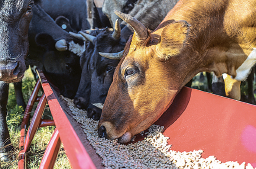
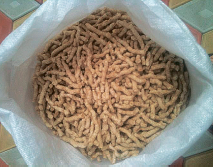
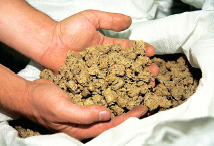
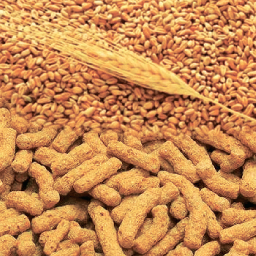
Switching over to extruded feeds will enable livestock breeders to reduce cattle’s mortality and diseases to almost zero. The extrudate is technologically simple, highly processed, and includes no harmful bacteria. The extruded feed is eaten with great relish by all the livestock, and even cats and dogs like it. There is no point to feed with ordinary unprocessed grain! The high digestibility is provided due to the porous structure and splitting of complex mineral elements into simple ones, as well as by the grinding of grain hull, which is perfectly digested then in the form of fiber.
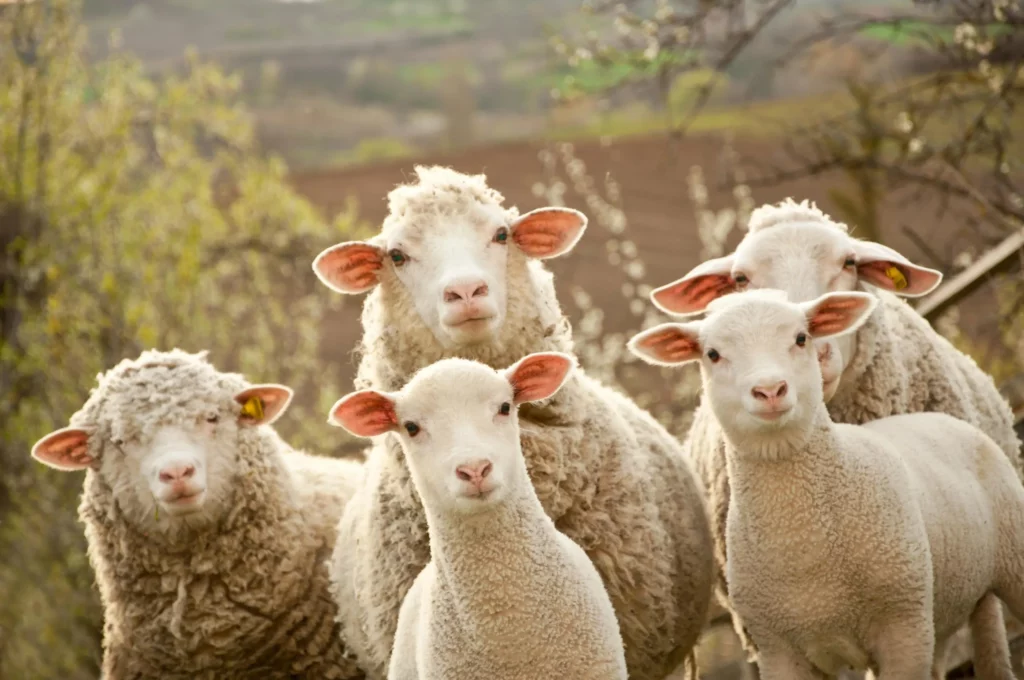
SHEEP, RAMS, HORSES
Raising sheep, rams, and horses at home is an interesting and profitable event, but the productivity of this livestock farming is greatly influenced by the type of feed and housing conditions. If animal’s feed consists of a large amount of fiber, then it can not digest food well, that means the animal will lose weight or it needs more food, and in that case, the costs of feeding will increase. That is why animal eat a special feed, which includes a lot of protein and a small amount of fiber. The extruded feed technology renders possible to ramp up carbohydrates, which quintuple the weight of products remaining in the animal’s organism after amylolysis. As a result the swine production cost is reduced by 30%.
Observations showed that when animals are fed with extruded feeds, the average daily gain is about 1.5-2 kg.
Animals readily eat feeds thanks to their eating qualities.
The simplest recipe recommended by experienced breeders is to mix two buckets of barley, half a bucket of wheat and grass meal, one-third bucket of corn, and three hundred grams of oil meal. All components are mixed and processed by an extruder. You can also base on recipes of certified feed compounds.
Therefore, fiber, barley, corn and wheat are mixed approximately in equal amounts — 20-25% of the total mass. Another 5% is sunflower meal. For adult animals, the amount of barley can be half of the total mass of products.
Universal farm grain grinder MKZ-300
Having spent time in extruding your grain mixture, you will realize an additional profit on a rapid increase in weight. Moreover, you will cut costs for other feed compounds, sprinkles, premixes, cereals and other expensive additives.
It is very efficient to use extruded feed to increase milk yield. Due to application of extruded feed, the milk yield increases by 20-40%. In addition, the feed consumption decreases by 8-12%, and mortality of animals caused by gastrointestinal diseases reduces by a factor of 1,5-2.
The extrusion allows reducing grain consumption by 30-40%. Increase in weight enhances by 50-100%. Feeding of bull-calf with extrudate gives a weight gain of up to 1.5 kg per day, milk yield — up to 5
liters per cow in terms of the value of milk of the highest grade. When feeding only with extruded feeds the time needed to feed bull-calf (up to 500 kg) reduces from 1,8 up to 1,2 years. In addition, most importantly, that the feeds are so effective in any feeding culture.
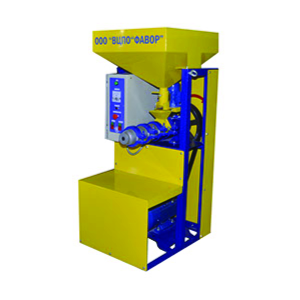
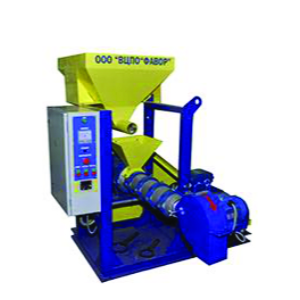
FOR SMALL GARDENS AND FARMS THE COMPANY «FAVOR» OFFERS A SMALL EXTRUDER WITH A PRODUCTION CAPACITY OF 40 KG PER HOUR. OUR MODEL DIFFERS FROM THE ONES OF OTHER MANUFACTURERS WITH A LARGE HOPPER, A STEADY BASE, EASY
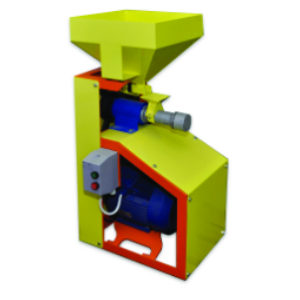
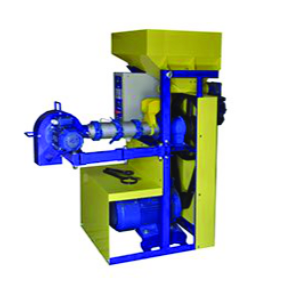
Extruder EK-40
feed extruder for small-scale farming and subsidiary farming
| Model | EK-40 |
| Production capacity, kg/h | 40 |
| Power, kW | 4 |
| Operating temperature, ⁰C | 100-180 |
| Dimensions, mm | 560×530×1060 |
| Weight, kg | 90 |
| Special features | Vibrating feeder |
PRICE: On request.
CATTLE BREEDING
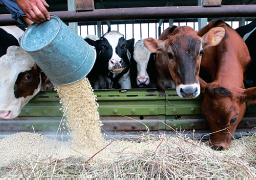
One of the reserves to increase the productivity of dairy herd and young-stock breeding, as well as to reduce milk and meat costs in agricultural enterprises is an extruded feed. It can be gradually introduced into the diet of calves from 10 days old.
The daily rate of input of feed is from 100 g per head. The feed is digested by 90% and gives an average daily increase in weight of 880-920 g per head. The feed is absolutely sterile, so it’s safe for calves. The edibility of the feed is very high because of its good eating qualities.
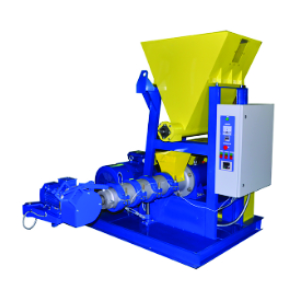
Feed extruder EK-100
feed extruder for small farming conditions
| Model | EK-100 |
| Production capacity, kg/h | 100 |
| Power, kW | 11,2 |
| Operating temperature, ⁰C | 100—180 |
| Dimensions, mm | 650×740×1560 |
| Weight, kg | 250 |
| Special features |
PRICE: On request.
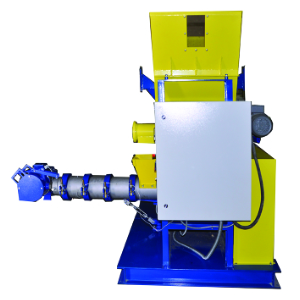
Feed extruder EK-100 PTO shaft
feed extruder for small farming conditions
| Model | EK-100 PTO shaft |
| Production capacity, kg/h | 100 |
| Power, kW | — |
| Operating temperature, ⁰C | 100—180 |
| Dimensions, mm | 650×740×1560 |
| Weight, kg | 150 |
| Special features | Operating from tractor with PTO shaft |
PRICE: On request.
Feed extruder EK-150 vibrating chute
universal feed extruder for farming conditions
| Model | EK-150 vibrating chute |
| Production capacity, kg/h | 150 |
| Power, kW | 18 |
| Operating temperature, ⁰C | 100—180 |
| Dimensions, mm | 650×930×1560 |
| Weight, kg | 350 |
| Special features | — |
PRICE: On request.
Feed extruder EK-150 screw
universal feed extruder for farming conditions
| Model | EK-150 vibrating chute |
| Production capacity, kg/h | 150 |
| Power, kW | 18,62 |
| Operating temperature, ⁰C | 100—180 |
| Dimensions, mm | 650×930×1560 |
| Weight, kg | 390 |
| Special features | — |
PRICE: On request.
THE COMPANY «FAVOR» SUCCESSFULLY PRODUCES EQUIPMENT FOR LARGE, MEDIUM AND SMALL AGRICULTURAL ENTERPRISES. THE FEED EXTRUDER IS THE IDEAL EQUIPMENT FOR PREPARING A NEW GENERATION FEED FOR YOUR LIVESTOCK.
The grain extruders are meant to be used for the quick preparation of dry feed with a digestibility of up to 95%. Prepared feed for 10-15 seconds! The grain extruders process: wheat, barley, corn, millet, rye, soybeans, peas, legumes, etc., — moreover you can add up to 20-30% of bran, shredded straw, other additives, including ones of animal origin to meal mixtures. Neither grains nor mixtures require prescalding. Cereal grains for more than 50% consist of starch that is poorly digestible for animals, especially young stock. In the extruder, in a very short time, a temperature reaches up to 160 degrees and a pressure up to 40 atmospheres. Under these conditions, the starch is hydrolyzed with increase in the amount of dextrins and common sugars, the structure of the cell walls is destroyed, and the fiber decomposes into secondary sugar. When the grains are ejected from the apparatus, the pressure sharply decreases, the water inside the cells turns into steam and increases in volume by a thousandfold. The structure of cells is blown up and the surface of grain components expands more than after milling, becoming more accessible for interaction with digestive juices and enzymes, while digestibility of feeds and their eating qualities improve.
FOR MEDIUM AGRICULTURAL ENTERPRISES the company “Favor” offers extruders with production capacity of 300-350 kg per hour
Feed extruder EK-300SH
universal feed extruder
| Model | EK-300SH |
| Production capacity, kg/h | 300-350 |
| Power, kW | 38 |
| Operating temperature, ⁰C | 100—180 |
| Dimensions, mm | 1650×1600×1565 |
| Weight, kg | 780 |
| Special features | Delivery output: Vibrating feeder |
PRICE: On request.
FOR LARGE LIVESTOCK FARMS, AS WELL AS FOR FEED-PROCESSING PLANTS, THE COMPANY “FAVOR” OFFERS HIGH PERFORMANCE EXTRUDERS
Feed extruder EK-500
feed extruder for industrial production conditions
| Model | EK-500 |
| Production capacity, kg/h | 500 |
| Power, kW | 58 |
| Operating temperature, ⁰C | 110—190 |
| Dimensions, mm | 2005×1650×2005 |
| Weight, kg | 1750 |
PRICE: On request.
Feed extruder EK-1000
high-performance feed extruder for industrial production conditions
| Model | EK-1000 |
| Production capacity, kg/h | 1000 |
| Power, kW | 90—110 |
| Operating temperature, ⁰C | 110—180 |
| Dimensions, mm | 2460×1920×1950 |
| Weight, kg | 2300 |
PRICE: On request.
HERB GRINDERS
RABBIT BREEDING
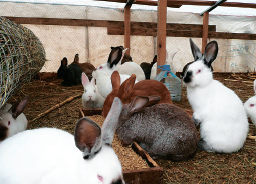
For an experiment on rabbits of the «silver» breed, a dry complete feed made by extrusion
process was fed under farm test conditions (data from website: dvor.ru). The following results
have been obtained: in the control group of five rabbits consuming extruded feed on the formula,
patented under number 2153811 by S.V. Zlochevsky, the average live weight at the age of 90 days was 4.4
kg. After the slaughter, carcasses had thin fat deposit on the blade-bones and abdominal cavity. The group
of animals consuming ordinary granulated feed had an average live weight of 3.5 kg at the age of 90 days. After the slaughter, the carcasses did not look very well-fed. Both groups were fed to appetite. In the meantime, the rabbits of the control group consumed an average 40 g of extruded feed daily less than rabbits fed granular feed. In such a case the feeding of baby rabbits with extruded food began at the age of 20 days, during the feeding of their doe rabbit, i.e., in the suckling period, and this was not noted at baby rabbits whose mother was fed with granulated feed. This observation made possible to seat apart baby rabbits of control group at the age of 25 days. This ultimately intensified increasingly the breeding, allowing the mating to take place on the 5th day after the kindling. It was also noted that at doe rabbits kept after mating on a diet with extruded feeds, the number of baby rabbits averaged 9.4. In the meantime, at doe rabbits who ate ordinary granular feed, this characteristic averaged 7.8.
The results of numerous trials regarding the efficiency of feeding rabbits with extruded feeds allow us to make the following conclusion: the application of the extrusion method in the manufacture of feed compounds for different classes of rabbits is more cost-efficient, since it allows to increase considerably the nutrient value of diets, and thus to intensify rabbits breeding.
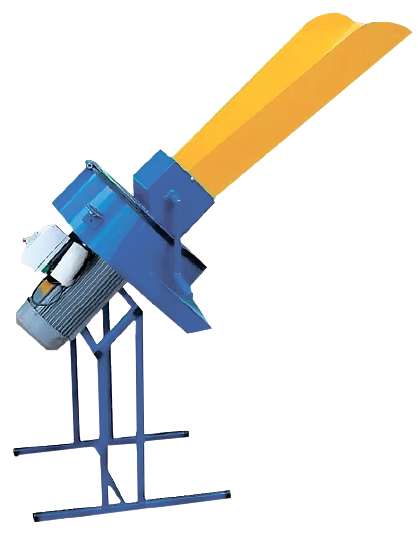
HERB GRINDER (GRASS, VELOUR GRASSES, STRAW, EXTRUDATE CHOPPER)
To reduce the cost of feed and increase the fiber content in the extrudate, up to 30% of chopped grass (velour grasses) can be added to the cereal mixture. For these purposes, the company “Favor” offers an inexpensive herb grinder TR-300.
Herb grinder TR 300
| Model | TR-300 |
| Production capacity, kg/h | 300 |
| Power, kW | 2 |
| Voltage | 220 |
| Dimensions, mm | 600×600×1200 |
| Weight, kg | 45 |
| Features | Chopping 1,5—2 cm |
PRICE: On request.
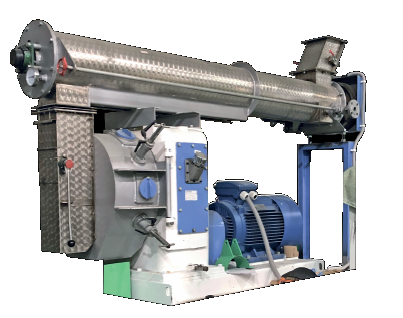
GRANULATORS
The success in preparing granulated feed compound depends largely on its composition. Generally, the feed compounds consist of cut wheat and maize. Those particular cereals are the most useful and favorite for poultry. Other ingredients of the feed may vary depending on the age of the hens.
For poults that need significant energy stores, fish meal, fish oil, soybean meal, vitamins (A, E, B), zinc, manganese can be added.
For adult fowl sunflower meal, wheat bran, salt, limestone meal, soda, fish meal are added.
| Production capacity, kg/h | 150 | 400 | 550 | 1000 |
| Matrix dimension | 150 | 200 | 200 | 200 |
| Voltage, V | 220-380 | 380 | 380 | 380 |
| Power, kW | 3 | 7,5 | 11 | 22 |
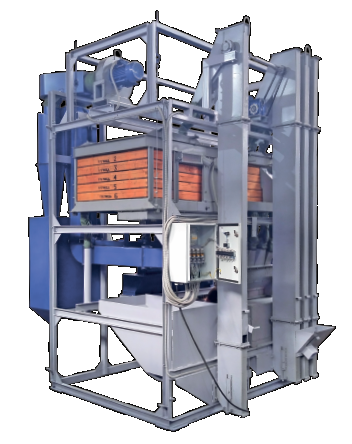
PEARLING MILL MKZ-300, UNIVERSAL FOR FARMERS
Pearling mill MKZ-300 is applied for processing of wheat, barley, millet, pea, maize and buckwheat in grit. Production capacity is from 150 to 450 kg per hour, it depends on the type of processed products.
Produced types of grits:
| — buckwheat, GOST 5550-74; | — poltavskaya meal 2, 3, 4, Artek, GOST 276-60; |
| — millet, GOST 572-60; | — peeled barley, pearl barley, GOST 5784-60; |
| — pea, GOST 6201-68; | — maize GOST 6002-69. |
Pearling mill MKZ-300 is mounted on a common frame with an integral control panel, which allows to shorten the start-up period as much as possible. Required space is 3×3 m². Required ceiling height is 4 m.
The advantages of grits MK3300
Supplied in full factory readiness, installation and dismantling can be carried out within 1 working day.
The grinder is mounted on a common frame with a single control panel, which makes it possible to reduce the installation time as much as possible.
The modular design of the cereal provides low power consumption (10.6… 17.6 kW per hour).
Allows you to process 6 types of raw materials. The transition from processing one type of raw material to another requires a minimum of time (1-2 hours).
No special preparation of the room and foundation arrangement is required for the installation of the cereal.
The service is provided by only 1 person.
Web site: www.kruporushka.favore.ru
| Series | Power | Dimensions |
| MKZ-300 universal | 14,6 | 2700×2500×3530 |
| MKZ-300 without buckwheat | 14,6 | 2700×2500×3530 |
| MKZ-300 only buckwheat | 10,6 | 2700×2500×3530 |
| MKZ-300 pearl barley, peeled barley | 10,6 | 2700×2500×3530 |
The weight of machine is about 3 tons. Operative personnel – 1 person.
STEAMER-DRYER
Designed for hydrothermal treatment of buckwheat with saturated steam at excessive pressure with subsequent drying of grain and its supply to the accumulator (hopper). Production is carried out in automatic mode. Not subject to registration with boiler supervision.
Technical specifications
| The type of installation is stationary | |||
| Efficiency: | steam generator – 80 kg/h | steamer – 140 kg/h | dryer – 140 kg/h |
| Installed capacity: | steam generator – 60 kW | steamer -1.1 kW | dryer – 2.2 kW |
| Overall dimensions | 2110х2600х4200 мм | Weight – 1800 kg | |
| Maintenance staff | 1 person |
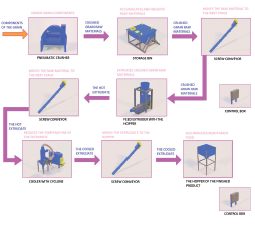
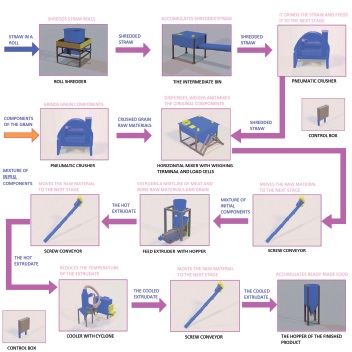
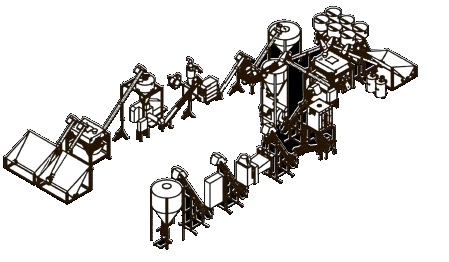
I. The Line of the extrusion of grain crops from 300 to 1000 kg/h
The line is designed for the production of extruded feed from grain crops for various groups of animals.
Complex carbohydrates are broken down into simple sugars during the extrusion process. The digestibility of the feed is increased to 90%. The feed is decontaminated, and pathogenic flora and pathogenic microbes die during the estruding process. It is possible to obtain a good-quality feed from grains affected by insects, fungi and mold. Vitamins and amino acids are preserved due to short-term exposure to temperatures.
The result is a safe, highly nutritious and well-digested feed.
Working process
Cereals are dosed, weighed and mixed at the site of preparation of the mixture. Then the finished mixture is extruded and the resulting feed is delivered to the cooling and unloading area.
Designed for hydrothermal treatment of buckwheat with saturated steam at excessive pressure with subsequent drying of grain and its supply to the accumulator (hopper). Production is carried out in automatic mode. Not subject to registration with boiler supervision.
Structure of the line
| № | Name | Quantity |
| 1. Mixture’s preparation area | ||
| 1.1 | Pneumatic crusher | 1 |
| 1.2 | Mixer | 1 |
| 1.3 | Weight frame with weight terminal and load cells | 1 |
| 1.4 | Conveyor | 2 |
| 1.5 | Hopper above the extruder | 1 |
| 1.6 | Control box for the mixing area | 1 |
| 1.7* | Storage bin | x |
| 2. A plot of extrusion | ||
| 2.1 | Extruder as a part of: | 1 |
| 3. Cooling and unloading area | ||
| 3.1 | Cooler (cyclone, fan, calmer) | 1 |
| 3.2 | Conveyor | 2 |
| 3.3 | Control box | 1 |
| 3.4* | Storage bin | x |
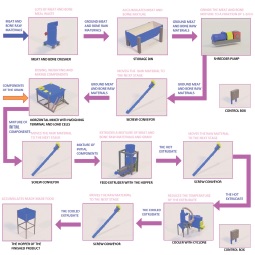
II. The line of the extrusion for waste from
meat processing / poultry processing waste / fish processing waste from 500 to 1000 kg/hour
The line is designed for the production of extruded feed from meat processing waste / chicken processing waste / fish processing waste
(slaughtering waste, livestock deaths, bones, offal, veterinary confiscations) mixed with a grain component for various groups of animals. This technology allows not only to solve the problem of recycling valuable biological products, but also to significantly save on feed for your own animals, as well as provide additional profit from the sale of a popular feed additive with improved quality characteristics.
The composition of waste extrusion lines includes an additional section — meat and bone.
Structure of the line
| № | Name | Quantity |
| 1. Meat and bone area | ||
| 1.1 | Meat and bone crusher / meat grinder | 1 |
| 1.2 | Meat and bone hopper with reverse | 1 |
| 1.3 | Shredder pump | 1 |
| 1.4 | Phase m/c control box | 1 |
| 1.5 | Storage bin | x |
*The hopper is not included in the price of the line and is additionally agreed with the Customer.
Working process
Meat processing waste (cattle, poultry, fish) is crushed
at the meat-and-bone site. Then the meat and bone mass and grain component are dosed, weighed and mixed at the site of preparation of the mixture. Then the finished mixture is extruded and the resulting feed is fed to the cooling and unloading area.
Recommended mixing ratio:
— meat / poultry / fish processing waste — 10–30%; — grain filler — 70–90%
III. The line of the extrusion from a mixture of hay straw with grain from 300 to 1000 kg/h
The line is designed for the production of extruded feed from a mixture of crushed hay-straw with a grain component for various groups of animals.
Working process
At the site of preparation of the mixture, the hay-straw and grain component are crushed, dosed, weighed and mixed. Then the finished mixture is extruded and the resulting feed is fed to the cooling and unloading area.
IV. The line of the extrusion and the pelletizing
with further coating from 500 to 1000 kg/h (production of fish feed)
| № | Name | Quantity |
| 1 | Roll granulator | 1 |
| 2 | Horizontal mixer | 2 |
| 3 | Extruder | 1 |
| 4 | Hopper with a 2 cu. | 1 |
| 5 | Conveyor L=6m with support | 1 |
| 6 | U-shaped conveyor L = 4m with support | 1 |
| 7 | Storage bin 5 cubic meters | 1 |
| 8 | Setting the dosage of additives | 1 |
| 9 | Installation of liquid component input | 2 |
| 10 | Cooler (cyclone, fan) | 1 |
| 11 | Conveyor L = 4m with support | 5 |
| 12 | Conveyor L = 6.5 m with support | 1 |
| 13 | Conveyor L = 5.5 m with support | 1 |
| 14 | Conveyor L = 3 m with support | 1 |
| 15 | Additive bin (left) | 2 |
| 16 | Hammer crusher | 1 |
| 17 | Additive bin (right) | 1 |
| 18 | Installation of finish spraying | 1 |
| 19 | Granulator | 1 |
| 20 | Weight frame | 1 |
| 21 | Hopper with a 4-cube agitator. | 1 |
| 22 | Table sifter | 1 |
| 23 | Bucket inclined conveyor 4 m 2 | 2 |
| 24 | Cooler (cyclone, fan) | 1 |
| 25 | Hopper 10 cubic meters. | 1 |
| 26 | Bucket inclined conveyor 3 m | 2 |
| 27 | Conveyor belt-scraper 3 m | 1 |
| 28 | The control box section of the extrusion | 1 |
| 29 | The control box of the pelleting area | 1 |
| 30 | The control box section of the dosing and mixing | 1 |
| 31 | The control box for the spraying and packing area | 1 |
PNEUMATIC LOADING UNITS
The use of a pneumatic loading unit allows to move grain products to the desired distance and height. The operation of the pneumatic loader is carried out by means of a vacuum in the pneumatic system.
The unit consists of a fan with an electric motor, a cyclone, a feeder with a geared motor, a polyurethane hose, a suction nozzle, an ejector. The unit is mounted on a mobile frame.
| Pneumatic loading unit | UPT-6 on wheeled dolly | UPT-10 on wheeled dolly | UPT-20 on wheeled dolly | UPT-30 on wheeled dolly |
| Production capacity, t/h | 6 | 10 | 20 | 30 |
| Power, kW | 12,1 | 23,1 | 39,2 | 62,2 |
| Suction line length, м | 3 | 3 | 3 | 3 |
| Transportation length, м | 10 | 10 | 10 | 10 |
| Lifting height, м | 4 | 4 | 4 | 4 |
| Unit weight, kg | 450 | 520 | 800 | 950 |
HOW IS OUR FEED EXTRUDER BETTER?
Our feed extruder is the heating of a compound feed mixture and a mechanical explosion. In this heating process, the pathogenic bacteria in the grain are destroyed, urea is converted into starch, and in the process of explosion, starch is converted into sucrose. This product is very well absorbed by the gastric tract of animals. At the same time, the digestibility of the product significantly increases, thereby ensuring greater growth and weight gain of cattle.
ALL MODELS OF EXTRUDERS ARE ALWAYS IN STOCK
THE DIFFERENCE BETWEEN OUR FEED EXTRUDER AND OTHERS
High reliability of components and assemblies
Ease of use, because it is made in Russia
The presence of protective and adjusting automation
Wear-resistant parts
Easy to disassemble, clean and maintain
Working bodies made of hardened steel
WHY THE FEED EXTRUDER OF OUR COMPANY.
Take your raw materials and come.
We will conduct a test test completely free of charge.
Would you like to check how your raw materials will be processed on our feed extruders?
WE CONDUCT FREE TESTING ON CUSTOMERS' RAW MATERIALS.
FAVOR – FEED EXTRUDERS No. 1 IN RUSSIA!
Do you want to reduce the death rate of livestock, save on the cost of ready-made feed, and increase the nutritional value of the diet?
Buy a feed extruder from us and feed the animals with your own compound feed!